
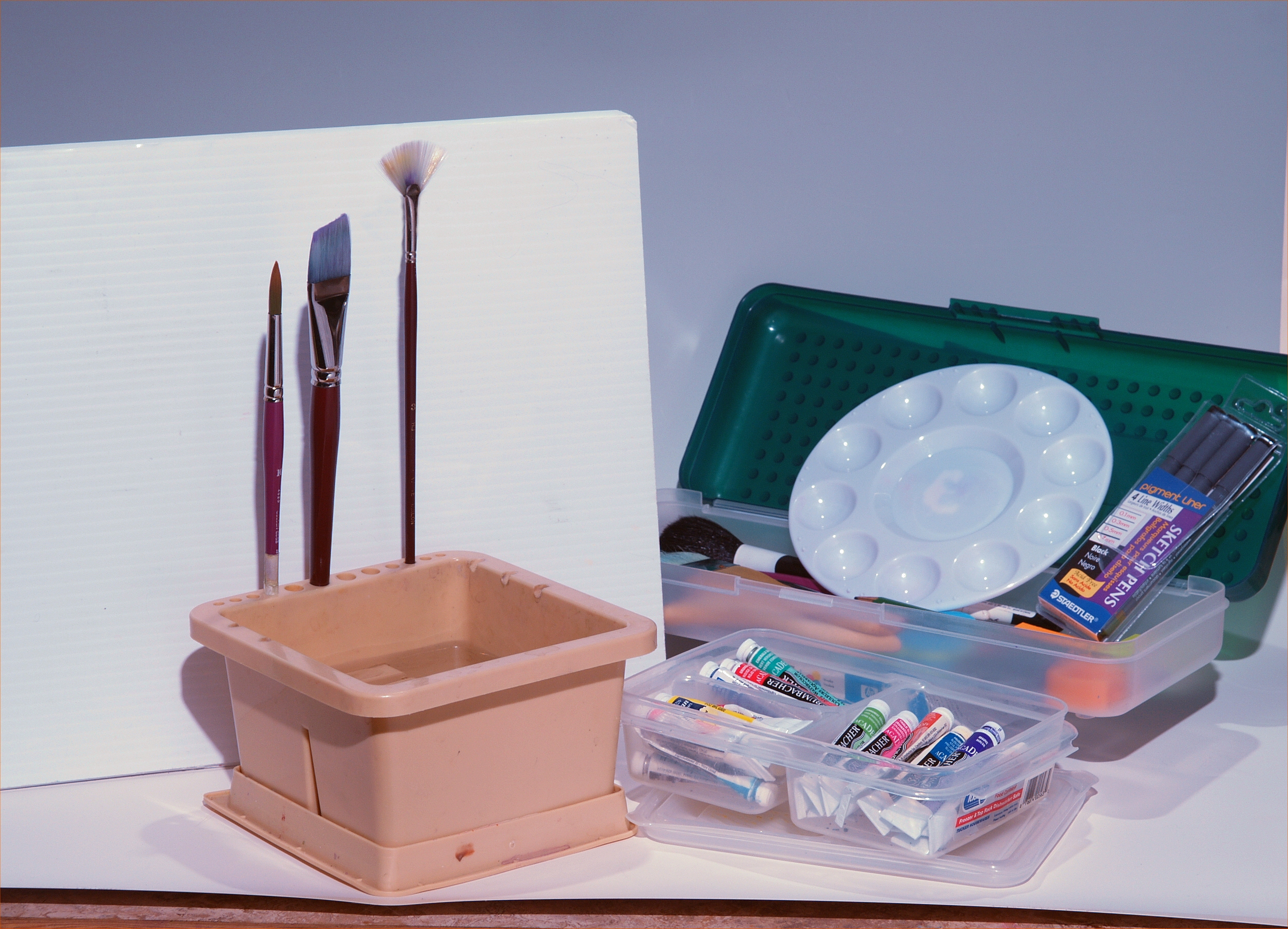
If you are an experienced painter and already have the necessary supplies, you may want to quickly skim the highlights of this part in the preparations just to be sure you have everything you need.
If you are a beginner, review the following carefully and make a list before shopping.
When purchasing supplies choose those of good quality. They will give you a sense of control as you paint, and make the experience much more satisfying than using those of lesser quality. Described below are those that I used to create the paintings in this book. They are relatively inexpensive and generally easy to acquire. Feel free to improvise as necessary. For your convenience, websites that provide online sales of supplies are listed at the back of this book. If you have the advantage of being located near an art and crafts retail outlet, seek the advise of the staff there. They can be helpful in assisting you select comparable brands if those suggested are not available.
Note:I used imperial measurements (i.e. inches, feet, yards) to prepare my own materials and to prepare the instructions for this book because I learned the imperial system well before metric measuring (i.e. millimetres, centimetres, metres) became a standard in my country. If you are most familiar with the metric system simply refer to the figure in parenthesis following each imperial measurement.
Paints: Grumbacher Academy Artists’ Watercolors comprise most of the tube paints in my personal collection.* They are good quality, cost-effective, and come in a large variety of colours. I also have a few Winsor & Newton tubes, both Artists’ Watercolor and the more economical Cotman.
Watercolor pencils, crayons and ‘pans’ (circular cakes that snap into trays) are fine, but tubes are preferred as they are more versatile and provide lots of opportunity for mucking about.
Four colors are all you need to begin, one each of the three primary colors—red, yellow and blue—and a green. Add those that appeal to your unique tastes.

Some that I used fairly extensively were Perylene Maroon, Cobalt Blue (Grumbacher Academy brand), Lemon Yellow (Winsor & Newton Cotman brand) and my ultimate favorite for surprise effects, Sap Green (Grumbacher).
You’ll find as you play with the colors that the three primaries, when mixed two at a time, will create secondary colors: green (yellow and blue), purple (red and blue), and orange (red and yellow). Particular shades will vary according to primaries chosen. Any three colors mixed together will create brown.
Brushes: The type of brush you choose for most of your painting will make a dramatic difference in how much you enjoy the process. The brush I employ more than any other is a Grumbacher Golden Edge (Series 4620) #10 pointed round. Mine has been in use for a decade-and-a-half and still gives me a nice clean point. My next favorite is an angular shader, a 1” White Taklon (Series 925), which I use for washes. There are watercolor brushes in all sorts of shapes and sizes, but you only need two similar to these to get started. If you would like to add a third for special effects, I suggest a small nylon fan brush, size 3 or smaller.
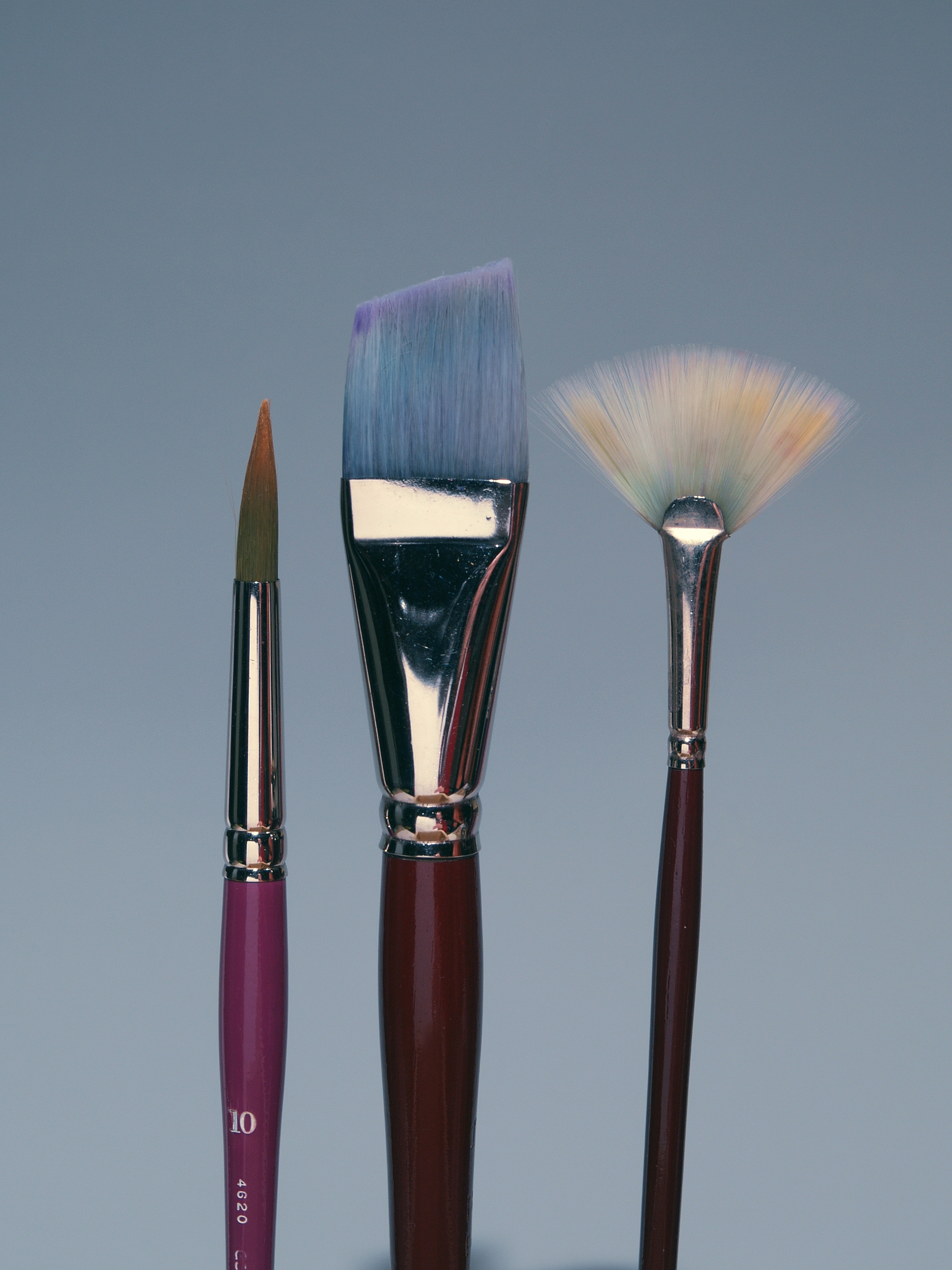
Left: Brushes that I use most.
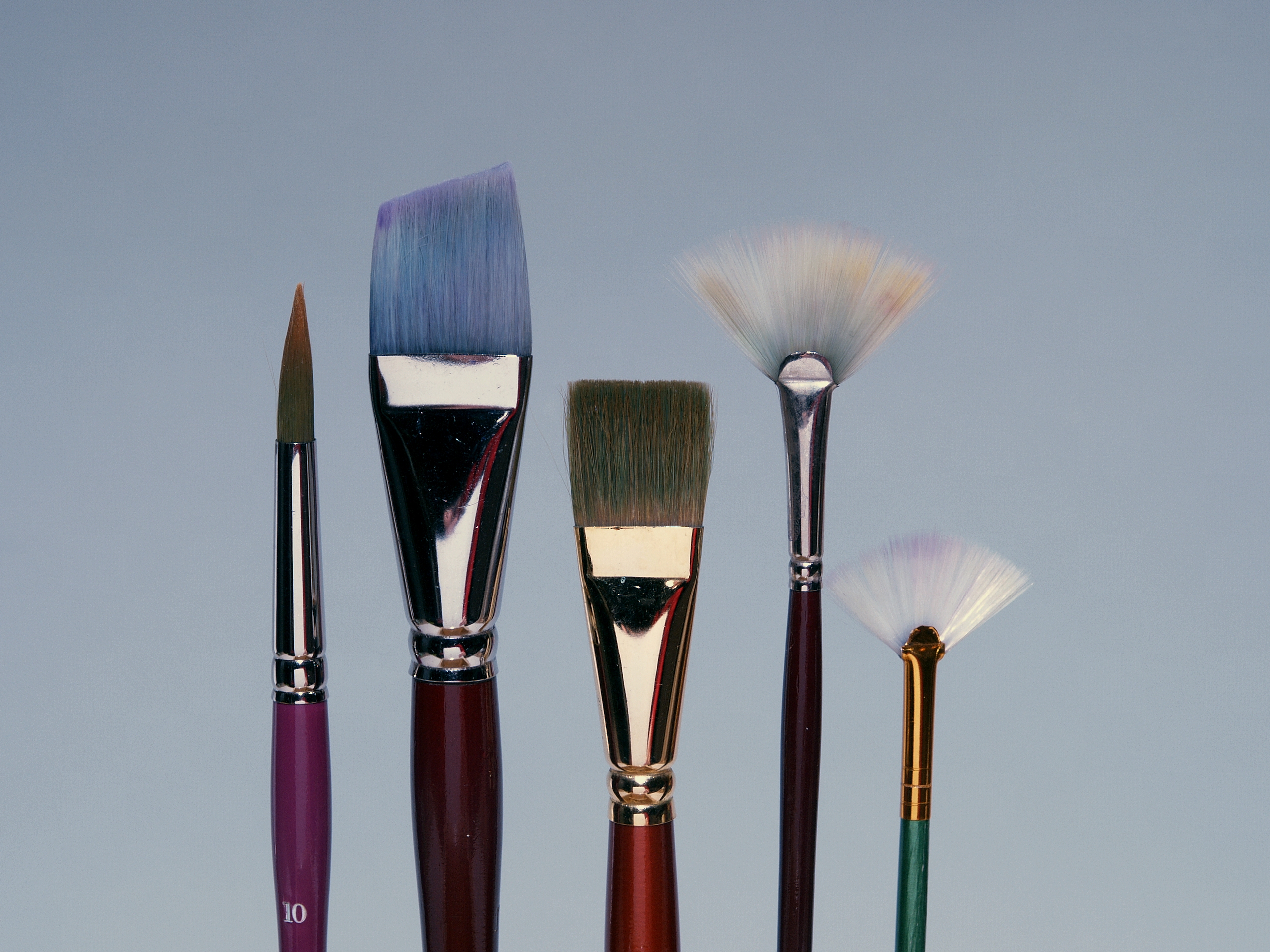
Above: Pointed round, angular shader, wash brush, fans. Brushes similar to the ¾” Winsor & Newton Sceptre Gold wash brush, shown in the center of this grouping, are more commonly used for washes than the angular shader, and may be easier to find.
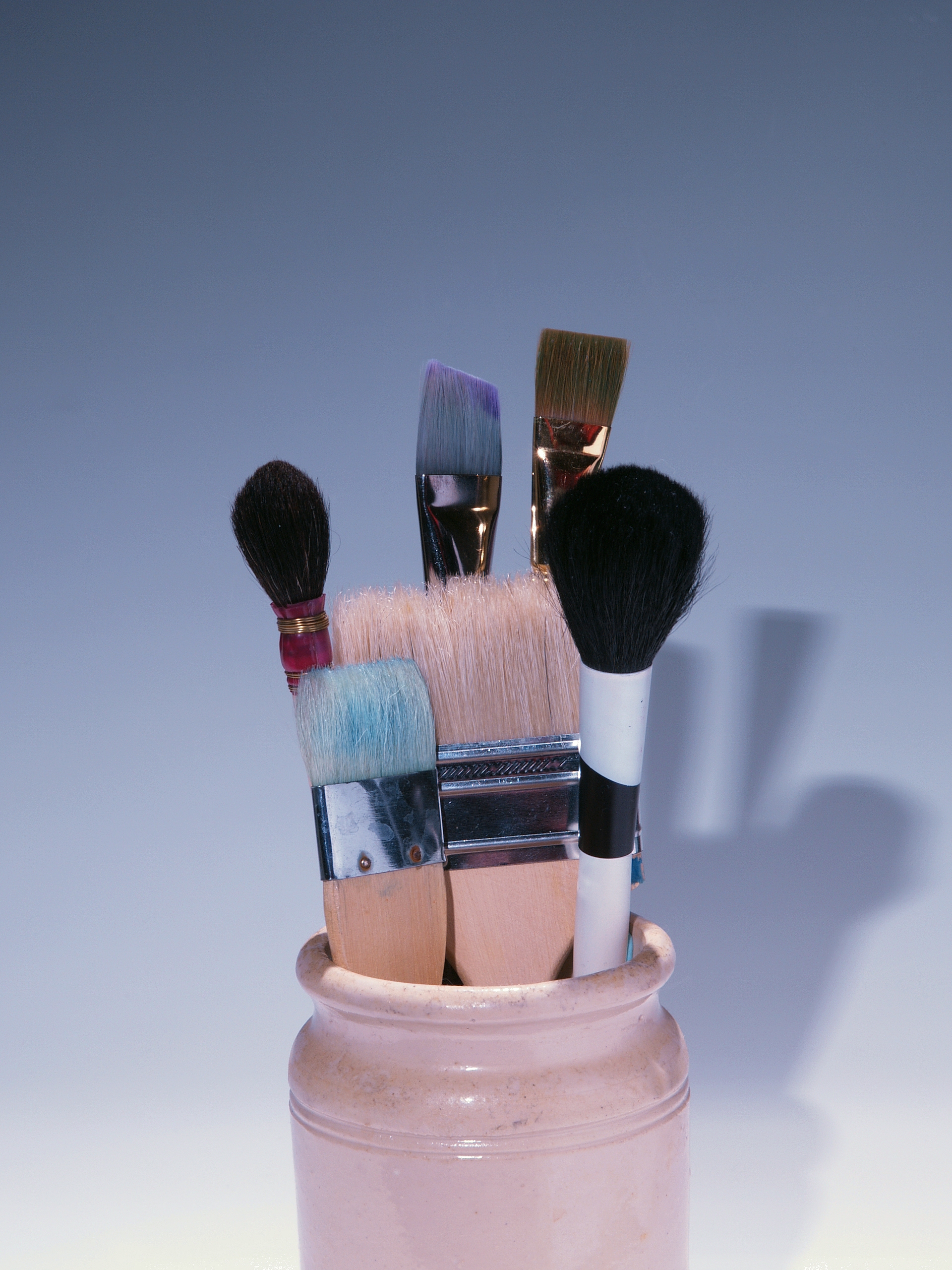
Brushes used by watercolorists for washes include mops and hakes. Both are very soft, generally natural-hair brushes used to create wonderful wash effects. If you’d like to experiment with one of these, I recommend a small mop to begin with. Several of the first washes in the Dark/Light paintings were created with a da Vinci Series mop brush, size 0.
Watercolor paper: I like both Arches and Winsor & Newton papers but I generally use Winsor & Newton Artists’ Water Color Cold Press 140 lb. (300 gms). It’s good quality, easy to find, and economical. You can buy it in sheets of 30″ x 22″ (760 x 560 mm) and sometimes get a great discount when you purchase a package of five, although one is plenty to get you started.
Palette: My preference is a round plastic palette with lid. It’s about 7” (12.5cm) across and doesn’t take up much room on the table. With the lid it’s very handy for traveling and storage. A suitable alternative is a small styrofoam tray or plate. Whichever you choose, it’s a good idea to have several on hand, although one is fine to begin with.
Backboard: You will need at least one flat, sturdy piece of wood or plastic, to which your cut papers will be taped. Corrugated plastic (eg. “Plasticore”) is ideal. It’s lightweight and cleans up well. My local Home Depot carries it in three sizes, any of which can be cut to the desired size of 12” x 16” (30 x 40cm).
Masking tape: 1” (24mm) wide preferably, although ¾” also works well. Almost any kind, white or green, will do but I favor Painters Mate Green. It has great sticking power and is easy to handle. A light green, it also makes for straighter borders, as it’s easier to see through when taping the edges of the paper to the backboard.
Containers for water and brushes: You will need two small glass jars for water, and one tall jar to store wet brushes in. Or, instead, a plastic water-well that is designed specifically for painting. Mine is about 6 ½” (17cm) square and has holes along one side to hold brushes. It’s compact, not terribly expensive, and might be found at your local art and crafts outlet.
Scissors, ruler or yardstick, pencil and kneadable eraser: These will be used to measure and cut your paper. A yardstick will make the job easier, but a 12” (30cm) ruler will do. If you have a choice, a 2B drawing pencil makes softer marks that erase better than those of a regular pencil. A kneadable eraser is best; it leaves no smudges.
Paper towel: Choose something absorbent and soft (which is easier on your brushes). One roll will last a very long time. I use Bounty.
Portfolio/Report Cover with Pocket: A paper or plastic cover, bag, envelope, approximately 9 ½” x 11 ½” (24 x 29 cm) will protect your papers before painting.
Sticky Notes: One small-medium sized pad.
Storage containers: Two small plastic containers with lids, one for your tube paints and another for your other small supplies. All can be kept together in a cloth bag or a box. Whenever you are ready to paint, simply bring out the storage container.
Waterproof sketch pens (optional): Not necessary, but great for adding fine details and/or lettering after painting. I use black Staedtler pigment liners, generally sizes .03 and .005.
Hand-held Hairdryer (optional): For quick drying between washes. I didn’t use one for the Dark/Light series but I do have a compact model I’ve found useful in other projects.
*Update: I used Grumbacher and Winsor Newton watercolour paints for years, loved them, and still have a few in my collection. More recently, I began using Daniel Smith Extra Fine Watercolors. They’re pricier but worth a try.
 Creating Recovery
Leave a comment